City of Tampa water is moderately hard to hard, which is why scale shows up on fixtures, shower glass and inside water heaters. A softener trades that hardness for sodium or potassium, and it needs a drain connection to flush itself. Call the number on this page to be connected with a local plumber in Tampa.
Why Tampa homes consider a softener
The City of Tampa Water Department reports finished water averaging about 211 mg/L of hardness, roughly 12.3 grains per gallon. Its FAQ describes typical hardness as 140 to 300 ppm, which is about 8 to 17 grains, and notes that it runs higher in the dry season. That is enough to leave white crust on faucets, cloudy spots on glass and scale inside a water heater tank or tankless heat exchanger.
What a softener does and does not do
- It removes calcium and magnesium by ion exchange, then regenerates with salt or potassium and flushes the waste to a drain.
- It does not remove chloramines. Tampa disinfects with chlorine plus ammonia, so taste and smell are a separate question from hardness, and a carbon filter is the usual tool for that.
- It does not fix low pressure caused by clogged galvanized pipe, which is a different problem in older homes.
Installation in a slab-on-grade house
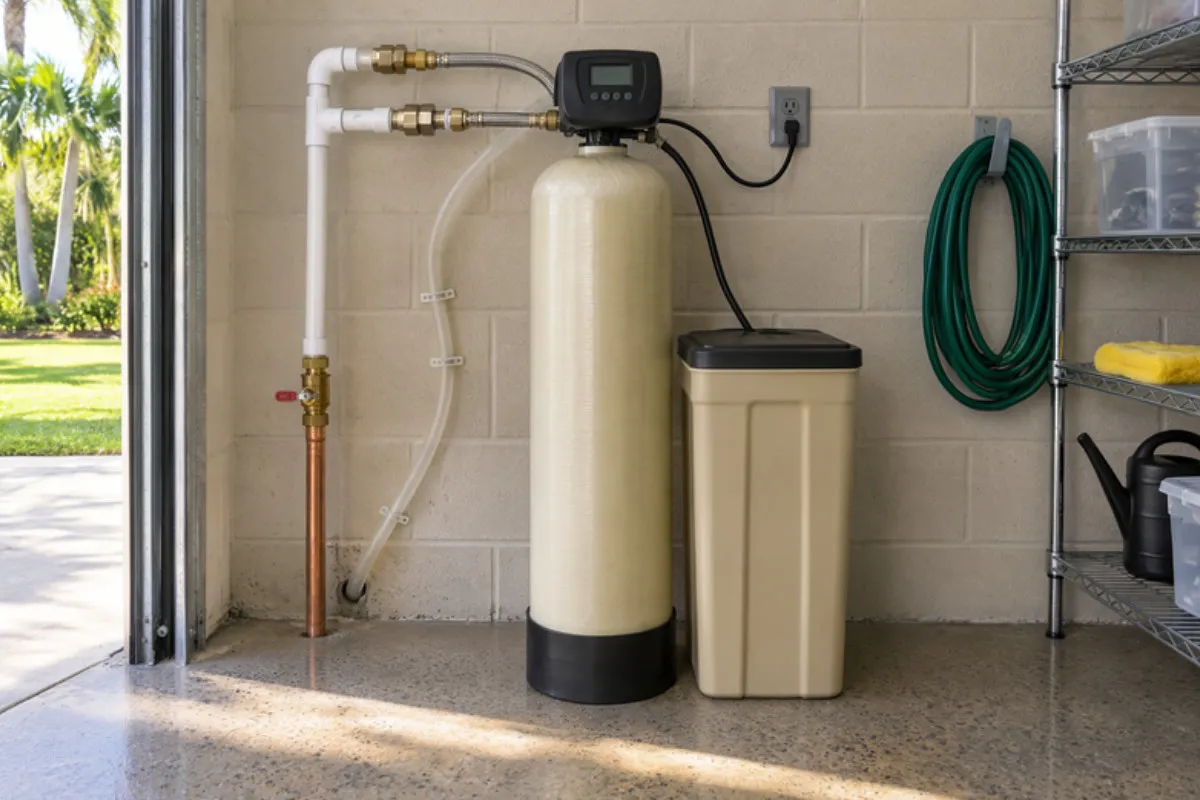
Most Tampa homes have no basement, so the softener usually goes in the garage or a utility closet, close to where the main line enters. The plumber needs a drain for the regeneration discharge, a power outlet, and a bypass so you can isolate the unit. The drain connection should keep an air gap so wastewater cannot siphon back into the softener. Tell the plumber if you have an irrigation system or an outdoor spigot, because those lines are normally plumbed ahead of the softener.
Repairs and common complaints
Salt bridges, a stuck valve head, a failed timer or a brine line clog are common reasons a softener stops softening. If water suddenly feels hard again, check that the salt tank still has salt and that the unit is regenerating. If it is leaking at the valve or running constantly, shut the bypass and have someone look at it.
Before you buy
Check your water bill and the City's water quality report for current hardness, since a home on a different supplier in the Tampa Bay area can see different numbers. Ask the plumber what size unit fits your household, what salt or potassium it uses, and where the drain line will run. Some households prefer to soften only the hot side or only the whole house, and a plumber can explain what each choice means for your fixtures.
How the referral works
Plumber Tampa is a referral service, not a plumbing company. You call, describe the job, and the call goes to an independent local plumber who sets the scope and price. Homeowners can confirm a contractor's state certification with the Florida DBPR Verify a Licensee search.
Water Softener questions from Tampa homeowners
Is Tampa water hard enough to need a softener?
Will a softener remove the chlorine taste?
Where does a softener drain?
Can a plumber repair my existing softener?
Related plumbing services in Tampa
Helpful guides
Water Softeners & Filtration in nearby cities and towns
Hillsborough County
Pinellas County
Pasco County
Hernando County
Polk County
Manatee County
Sources
Last updated: